The Real Choice in New Zealand Betting, and What the Alternatives Actually Cost
 Available in US
Since 28 June 2025, betting on sport or racing from inside New Zealand has had one lawful provider. Section 74AAA of the Racing Industry Act 2020 puts TAB NZ — operating through its two online brands, TAB and Betcha — in a position no other New Zealand bookmaker occupies, because the section forbids anyone else from taking that bet. The change was not abstract: the Department of Internal Affairs told operators without that status to withdraw from New Zealand customers with immediate effect, and the offshore brand most readers have heard of is now operating in this country outside the law that covers betting here.

That monopoly is the starting point of any honest comparison. A site called “new” or “best” is not lawful for New Zealand customers whatever it calls itself. This page works from that fact first and ranks the alternatives second, because a comparison that starts with the alternatives has quietly answered the legal question already.
30 October 2026 — the figures below were checked against the Department of Internal Affairs gambling register guidance and TAB NZ’s published betting rules at the time of writing.
Table of Contents
- What the Law Actually Changed in 2025
- What a Punisher Gambler Loses by Betting Offshore
- Who Actually Protects New Zealand Punters
- What Crypto and Anonymity Do Not Buy in New Zealand
- How Quickly Punters Get Paid and What They Pay For It
- How Predictors, Forecasts and Tipsters Fit Into the Picture
- What the Odds and Markets Actually Look Like
- What the Fixtures and Tournaments Look Like for a New Zealand Reader
- The Top 10 Compared Side by Side
- What Each Operator’s Own Terms Say
- The Mechanics Every Punter Has to Internalise
- A Direct Comparison of the Cost Shape
- What to Read Before Depositing Anywhere
- The Costs a Punter Pays That Are Not on the Betting Slip
- What This Page Is Not For
- What a Punter Must Walk Away With
- Frequently Asked Questions
What the Law Actually Changed in 2025
The amendment sits in section 74AAA of the Racing Industry Act 2020, in force from 28 June 2025. It says, in plain terms, that no person other than TAB NZ may offer racing betting, sports betting or other racing or sports betting to a person in New Zealand, regardless of where that person is resident or where the company is incorporated. There is no licence to apply for and no licence register of bookmakers, because the regime never needed one: with one lawful provider, a register lists one name.

The operational picture behind the statute matters as much as the statute. TAB NZ’s commercial partner is Entain, which runs the betting business under a 25-year partnership signed in 2023. The deal gives Entain a 50/50 share of gross profits and guarantees TAB NZ at least $150m a year for the first five years; Entain also paid $100m up front into the racing sector. The point for a punter is what the partnership delivers: a single product, governed by TAB’s own published betting rules, sold under the TAB and Betcha brands. Entain’s involvement is the reason a Betcha app — first released on 6 August 2024 — sits on a New Zealand phone rather than on a shelf somewhere. The brands do not compete with each other; they are two doorways into one operator.
What the law does not do is block access. New Zealand does not geo-block offshore websites, and no payment-blocking order or bank obligation has been published to stop money moving to a Curaçao-licensed bookmaker. The penalty lands on the operator: anyone offering racing or sports bets to a New Zealand resident in breach of section 74AAA is breaking New Zealand law, but the published penalty is not stated in the section itself, and no prosecution of an offshore bookmaker has been recorded. For the player, section 19(4) of the Gambling Act 2003 (inserted in 2025) says an individual cannot be convicted for placing such a bet. That is exactly what the statute says, and not a line further than it — the legal status of a player placing an offshore bet is neither “illegal” nor “legal” in any published sense. The Department of Internal Affairs has framed its public warnings around the consumer risk: an offshore operator may sit in a jurisdiction with minimal safeguards, may refuse to return unspent credits and may not pay out a large win.
The Online Casino Gambling Act 2026 changes one corner of the picture but not the one a sports punter asks about. It creates a licensing regime for online casino gambling in New Zealand and allows TAB New Zealand to apply for an online casino licence — a casino licence, not a sports-betting licence. Casino and betting stay separate permits, with separate rules, separate age limits and separate consumer protections. TAB NZ winning the right to apply for a casino licence does not extend the betting monopoly one inch.
What a Punisher Gambler Loses by Betting Offshore
The honest reading of “lawful” here is protection, not safety in the abstract. Three things change when a New Zealand punter walks outside TAB NZ.

The first is the complaints route. A punter with TAB NZ has the Department of Internal Affairs and the operator’s own disputes process, both within reach under New Zealand consumer and gambling law. A punter with a Curaçao-licensed sportsbook has neither: the licence is issued by an authority that does not enforce New Zealand consumer protection, and the operator’s terms route disputes to an arbitration clause the punter signed at sign-up. Betting with offshore brands means accepting that the leverage available against an operator who refuses to pay out is whatever an overseas regulator is willing to provide.
The second is the harm-minimisation framework. TAB NZ’s apps list deposit limits, time-outs and self-exclusion, and a self-exclusion applies across both TAB and Betcha brands — a single exclusion covers both doorways into the same operator. An offshore bookmaker’s safer-gambling tools exist by the operator’s own choice. They can be good or thin, and nothing forces them to remain either way.
The third is the published tax position. Recreational gambling winnings in New Zealand are generally not taxable under Inland Revenue guidance, and prize money from TAB horse, dog and trotting races is explicitly outside the tax base. A punter who bets as a business is a different case entirely, and the line between “recreational” and “business” is a question for an accountant, not a betting site. The clean rule: recreational winnings from a New Zealand account do not trigger income tax. Offshore winnings reach the same general rule through the same Inland Revenue guidance, because tax status depends on the punter’s circumstances, not on the bookmaker — but a punter relying on offshore product has no operator-side confirmation of how a particular win was logged.
A common reading collapses those three losses into one and gives the answer “TAB is safe, the rest is risky.” That is not what the page is saying. TAB NZ and Betcha carry New Zealand harm-minimisation tools, regulator oversight and a complaint route; offshore brands run on their own house rules, with no New Zealand complaints route, with DIA’s stated risks, and with limits that may be larger or smaller than TAB NZ’s depending on the brand. Neither group is “the safe choice” by default; the framing is a comparison, not a verdict by category.
Who Actually Protects New Zealand Punters
TAB NZ’s published app listing sets out the tools a punter can switch on inside the product: deposit limits, time-outs and self-exclusion. The exclusion covers both TAB and Betcha, so a punter who excludes from one brand is excluded from the operator as a whole. The 17+ App Store age rating is an Australian-and-NZ storefront default; TAB NZ’s own rule, stated on the same listing, is that customers must be 18 or over to bet — betting under 18 is an offence under section 89 of the Racing Industry Act 2020.

Land-based casino venues in New Zealand run on an age of 20; the betting age is 18. The two are different products with different licences and the gap is not a typo or an oversight. A punter who walks between a casino floor and a TAB account without recalibrating their assumptions is reading the wrong rule for the door.
The helpline work sits outside the betting operator. The free Gambling Helpline (0800 654 655) and the text line 8006 are run by services funded through the gambling-harm system, not by the bookmaker. TAB NZ’s app lists them because the regulator expects the operator to surface them; the service itself is independent. Safer Gambling Aotearoa is the umbrella name for the harm-prevention work the levy pays for. TAB NZ pays a Problem Gambling Levy of 0.74% of its gross proceeds, in force from 1 July 2025 to 30 June 2028, into the same system.
There is no single national online-betting exclusion register. The register the Online Casino Gambling Act 2026 will set up is for online casinos, not for sports and racing bookmakers. Excluding from TAB NZ today means excluding from TAB NZ, with the spread of the exclusion covering its two brands; a punter who has bet with offshore brands and decided to stop has to ask each brand’s own customer-service team to close the account and to switch on whatever self-exclusion the operator offers at the time. There is no central register that enforces it across brands.
What Crypto and Anonymity Do Not Buy in New Zealand
Crypto sportsbooks and esports books built around Bitcoin or USDT dominate a large slice of the offshore comparison. The honest read of that comparison in a New Zealand context: the legal status of the bet is the same whether it is funded in New Zealand dollars or in Bitcoin. Section 74AAA does not distinguish by payment method, and a Curaçao-licensed crypto bookmaker taking New Zealand customers online is in the same position under New Zealand law as a Curaçao-licensed card-funded one. A punter’s anonymity at the funding layer does not change the lawful status of the bet at the receiving end.

What crypto does change is the operator side. A crypto-native bookmaker settles in the coin the punter deposited with, pays out in the same coin and lives inside the punter’s wallet rather than inside the punter’s bank. That has practical consequences: refunds arrive in the coin they were sent in, exchange-rate exposure sits with the punter, and the disputes path is whatever the operator’s terms say rather than whatever a New Zealand bank says. A punter looking for “no ID verification” through crypto must read the small print more carefully than the marketing: most licensed crypto bookmakers still run KYC at withdrawal thresholds, and verification at withdrawal is the moment a payout is at stake — the worst possible time to discover the rule.
VPN use is in the same category. Nothing published establishes a New Zealand rule on VPN access to a betting site, and nothing establishes a rule against it. What the law does establish is that the site accepting the bet is in breach of section 74AAA if it knowingly takes racing or sports bets from a New Zealand resident. A VPN does not change that fact at the operator’s end, because the operator is breaking New Zealand law either way. A punter who routes through a VPN has changed the path, not the destination.
How Quickly Punters Get Paid and What They Pay For It
There is no statutory rule on payment methods or payout times for New Zealand betting accounts. TAB NZ’s deposit methods and limits are operator-level terms, set out in the product itself. The regime that does have a rule is the point-of-consumption charge on offshore racing and sports bets, which ceased on 30 June 2026 — a date that mattered more to offshore operators than to New Zealand customers, because the charge sat on operator profits, not on bets.

For a punter, the practical payout comparison runs inside TAB NZ versus inside an offshore bookmaker’s own house rules. TAB NZ’s published terms govern withdrawals in the same currency the punter deposited, with limits and methods set by the brand. Offshore brands vary widely on payout time, payout currency and payout method — one bookmaker offers crypto in the same coin in hours, another runs a forty-eight-hour internal review on every first withdrawal. The comparison is not “TAB is faster” or “offshore is faster” — it is “the speed you will see is whatever the operator you chose has published, and you look at the published terms before depositing.”
The escrow question is the sharper one. An offshore operator’s terms almost always allow the operator to hold funds for “review” or “security” purposes, and “review” is not a defined term in any consumer-facing sense. A punter who hits a withdrawal delay at an offshore bookmaker is bargaining with a counterparty in another jurisdiction, under another jurisdiction’s rules. The Department of Internal Affairs’s published warning that overseas operators may not return unspent credits and may not pay out large wins is the consumer-facing version of that fact.
How Predictors, Forecasts and Tipsters Fit Into the Picture
Prediction sites and tipster services live one layer outside the betting operator, and the New Zealand monopoly does not reach them: a tipster can publish tips for any event, anywhere in the world, and the law does not care, because the law does not regulate tipsters. What the regulator does police is the betting operator, and a tipster service that takes a subscription from a New Zealand reader is in a different business from the bookmaker that takes the bet.

What that means for the reader of a tips page: a tip carries no obligation from the regulator that polices the betting side. The tip is somebody’s view of an outcome; the bet is the punter’s decision; and the margin sits inside whichever price the bet is struck at. A tipster who promises a winning strike-rate is selling a forecast, not a product; the reader pays for the forecast and the regulator says nothing either way.
The math of betting — payout, margin, expected loss — is what sits underneath every tip, every accumulator and every prediction. A punter who understands those three numbers reads a tips page differently from one who does not, because the page can be pricing in a margin that the tipster did not disclose. Tips pages are useful when they explain the case for a price and useless when they sell certainty. The New Zealand comparison does not change that framing: TAB NZ’s prices carry the same kind of margin any bookmaker’s prices carry, and a tip on a TAB NZ event is exposed to that margin in exactly the same way as a tip on an offshore event.
What the Odds and Markets Actually Look Like
A bookmaker’s odds are a market view, not a probability. The view includes the bookmaker’s margin, which is the fraction of every dollar bet that the bookmaker keeps on average across the market. For an illustrative two-way market priced at decimal odds of 1.90 against either side, the implied probability of each side is 1/1.90, the two implied probabilities sum to roughly 1.053, the payout share is the reciprocal of that sum (about 95.1%), and the margin is roughly 4.9% — landing somewhere in the band of 4.5% to 5.5% depending on how the same numbers are rounded. The point the arithmetic makes: even a “fair” two-way market has the bookmaker taking close to five cents in the dollar across the market, regardless of which side wins.
For a punter, the margin looks like this: in a market where TAB NZ prices the All Blacks at 1.90 and the Wallabies at 1.90, the bookmaker takes about five per cent of every dollar matched on that market. A punter betting $10 on the All Blacks at 1.90 gets back $19 if they win; the punter betting $10 on the Wallabies at 1.90 gets the same $19 if their side wins. Across the whole market, the bookmaker keeps the gap between what it pays out in total and what it took in. The margin is the bookmaker’s edge; the odds are the punter’s price. The two are linked: every price is 1 / (1 + the bookmaker's edge on this market), and a punter who reads the price without reading the margin is reading half the line.
The set of available markets depends on the operator. TAB NZ’s product spans horse, harness and greyhound racing, rugby union, rugby league, NRL, NBA, NFL, tennis, cricket, football, motorsports and esports, with fixed-odds and tote (pool) bets and a range of bet types — Win, Place, Each Way, Quinella, Exacta, Trifecta, First Four, Double, Treble, Daily Double, Running Double, Quaddie, Big6, Multis and Same Game Multis. Offshore brands offer much wider event menus (Champions League to the NFL, plus UFC and table tennis) and a wider range of market types per event — one international sportsbook lists more than 30 market types per event, including 1X2, Double Chance, totals, both teams to score, correct score, HT-FT and a full tennis menu of game, set and handicap markets. The wider menu is a real product difference; what it is not, in this jurisdiction, is a lawful product difference.
The cash-out feature appears widely across offshore brands and is built into the TAB NZ apps as well. A punter who has placed a multi can lock in a smaller return before the last leg has been decided, or cut losses on a leg that is going wrong. The mechanic is the same anywhere — the bookmaker offers a price, the punter accepts it, and that price is whatever the bookmaker wants to pay at that moment. The cash-out price is rarely the same as the actual edge at the moment of the cash-out; the gap is the bookmaker’s cut on the cash-out.
A Bet Builder is the same shape of trade dressed up differently. The punter combines selections from a single event (same-game multi), the bookmaker prices the combination rather than the individual legs, and the margin on the combination is the bookmaker’s choice. A Sportaza-style rule, where one voided selection voids the entire betslip, is the house rule that protects the bookmaker when a leg goes non-runner. The punter’s defence is the same as for any market: read the rule before placing the bet, because the bookmaker has written it.
A live or in-play market is a market struck after the event has started. TAB NZ offers live betting through its apps, including in-play racing products. The offshore live product is the largest of the three product categories — pre-match, live, and everything else — and the operator’s published rule on suspension of markets at a key event decides whether a live bet is honoured or voided. No statutory New Zealand restriction on in-play markets is established; what governs in-play is the operator’s own rule.
What the Fixtures and Tournaments Look Like for a New Zealand Reader
New Zealand readers bet on a calendar that runs rugby in winter, cricket in summer, horse racing year-round and football codes in their own seasons. The Rugby World Cup sits at the top of the rugby calendar, with the All Blacks as the home team’s draw; Super Rugby Pacific feeds the test squad; the NPC runs the provincial depth chart. Rugby league sits in NRL — a trans-Tasman competition with Warriors as the New Zealand entry. Cricket’s international calendar runs the Black Caps through test series, ODIs and T20Is, with the domestic Plunket Shield and Super Smash feeding underneath. Melbourne Cup day in November is the headline racing date for thoroughbreds, and harness racing (“the trots”) fills the off-season with meetings every week.

Football runs through the English Premier League, the A-League and the OFC Champions League; basketball through the NBA; American football through the NFL; tennis through the four Slams; UFC through numbered events; motorsport through Formula 1. Esports sits at a different remove — CS2, League of Legends, Dota 2 and Valorant are the four games with the deepest market coverage across the offshore books, and the question of whether esports betting is “sports betting” under the Racing Industry Act is not established.
Greyhound racing is closing. The code is being wound down in stages from 1 August 2026, and from that date offshore operators may not take bets on greyhound races either — the racing-code ban extends in step with the code’s closure. A punter with a greyhound bet on 1 August 2026 and after is betting into a market the law has closed.
The Top 10 Compared Side by Side
The comparison below puts TAB NZ’s two brands first, then the offshore bookmakers New Zealand readers encounter. The “brand” column shows the name a reader meets at sign-up; “New Zealand status” shows whether the brand is one of TAB NZ’s two online brands or an operator without a New Zealand licence; “what the operator’s own terms state” is the subject the plan routes the row to. There is no second column for “is it safe” or “is it recommended” — a column of verdicts by row defeats the comparison the table is built to make.
| Brand | New Zealand status | What the operator’s own terms state on the subject |
|---|---|---|
| TAB | TAB NZ brand (the only lawful online sports and racing bookmaker with TAB NZ) | RACING INDUSTRY ACT 2020, SECTION 74AAA: the only lawful route; TAB’s published betting rules define Win, Place, Each Way, Quinella, Exacta, Trifecta, First Four, Double, Treble, Daily Double, Running Double, Quaddie, Big6, Multis, Same Game Multis; 17+ age rating; 18+ to bet |
| Betcha | TAB NZ brand (the second lawful online sports and racing bookmaker with TAB NZ) | Betcha is the second of TAB NZ’s two online brands, run by Entain NZ since August 2024; horse, greyhound and harness racing plus rugby, NRL, MMA/UFC, NBA, NFL, tennis, cricket, football, motorsports and esports; 18+ only |
| Thunderpick | NOT licensed in New Zealand | Curaçao licence; esports-first bookmaker (CS2, League of Legends, Dota 2, Valorant); sportsbook with cash-out; markets span Champions League to NFL |
| 22Bet | NOT licensed in New Zealand | Curaçao licence; 30+ market types per event including 1X2, Double Chance, totals, both teams to score, correct score and HT-FT plus tennis game, set and handicap markets |
| Sportaza | NOT licensed in New Zealand | Anjouan licence; pre-event cash out, Bet Builder, multiples, Asian lines, interval markets (1/5/10/15 minutes); one voided Bet Builder leg voids the whole slip |
| RTbet | NOT licensed in New Zealand | Curaçao licence; football, tennis, table tennis, basketball, ice hockey, American football, baseball; live betting and virtual sports |
| BillyBets | NOT licensed in New Zealand | No licence that applies in New Zealand; casino, live casino and sportsbook on one account; sportsbook covers football, tennis, table tennis, basketball, ice hockey, American football, baseball, combat sports, esports, virtual sports and live betting |
| BigClash | NOT licensed in New Zealand | Curaçao licence; pre-match and live sports betting across international and local leagues; virtual sports and esports betting on FPS and MOBA titles |
| BetAlright | NOT licensed in New Zealand | No licence that applies in New Zealand; football, tennis, table tennis, basketball, ice hockey, American football, baseball; Live Betting and Virtual Sports sections |
| Glorion | NOT licensed in New Zealand | No licence that applies in New Zealand; pre-match and live betting, virtual sports, horse racing and esports; markets grouped into popular, niche, indoor and outdoor sports plus entertainment (award shows, elections) |
Two readings of the table deserve a few sentences around it. The first is that the first two rows are not in competition with the rest. A “10 best” list that ranks TAB and Betcha against offshore brands is a list that has answered the legal question before it asked it, because a punter who bets with an offshore brand is betting outside the law the regulator enforces. The second is that the offshore rows are not equal either — the licences differ (Curaçao versus Anjouan versus no published licence that reaches New Zealand), and the product depth varies widely. The same column set does not argue the products are the same; it argues the legal exposure they share, with the rest of the differences pushed into the row text.
What Each Operator’s Own Terms Say
A ranking that stops at the table has described the operators without judging them, and judging them is the work the table does not do. What follows is the per-operator read.
TAB (TAB NZ brand — the lawful New Zealand bookmaker)
TAB is the older of TAB NZ’s two online doorways and the brand most New Zealand punters have placed a bet with at some point. The product is fixed-odds and tote (pool) betting on racing and sport; the published betting rules define each bet type in detail and the rules are the rule the punter has agreed to. Trackside live race streaming with in-app betting, racing form, Blackbook and Jockey Challenge tools sit inside the app alongside a simplified wallet for deposits and withdrawals; the same exclusion covers both TAB and Betcha, so a punter who self-excludes at TAB does not need to re-do the paperwork at Betcha.
The wagering requirements, deposit methods and limits are published inside the product, and a punter who has bet on TAB NZ previously has seen the bones of the offer — the bonus bet size, the minimum odds, the expiry window — before. What TAB NZ does not offer is the offshore menu: the event range is narrower than the widest offshore books, the in-play suite is smaller, and the esports coverage is less detailed. The trade is the trade the law sets: a narrower product, governed by New Zealand rules, with a regulator the operator answers to.
The verdict on TAB is the verdict the law already gives: it is the only lawful New Zealand bookmaker with TAB NZ, and the breadth-versus-protection trade it asks the punter to make is the trade the law has made for them. The breadth is smaller. The protection is real.
Betcha (TAB NZ brand — the second lawful online bookmaker with TAB NZ)
Betcha is the newer of TAB NZ’s two brands, released on the New Zealand App Store on 6 August 2024, and the one with the smartphone-first app the offshore brands’ product looks like. The product set covers horse, greyhound and harness racing plus rugby, NRL, MMA/UFC, NBA, NFL, tennis, cricket, football, motorsports and esports — a wider menu in marketing copy than TAB’s, because the same coverage in less marketing-savvy hands looks narrower.
The reason a punter might pick Betcha over TAB is the product surface: the app was built in a different era for a different device, and the experience reflects it. The reason a punter must not pick Betcha over TAB on the legal question is that there is no question to ask — both brands are TAB NZ’s, both fall under the same Racing Industry Act regime and the same TAB NZ published betting rules, and a punter placing a bet on Betcha is placing a bet at TAB NZ.
The verdict on Betcha is the verdict on its operator: it is the only lawful New Zealand bookmaker with TAB NZ, and choosing between TAB and Betcha is a product call, not a regulatory one.
Thunderpick (NOT licensed in New Zealand)
Thunderpick is an esports-first offshore bookmaker with a Curaçao licence (OGL/2024/677/0722), holder Paloma Media B.V. The published product covers CS2, League of Legends, Dota 2 and Valorant in depth, with a sportsbook that spans the Champions League to the NFL and a cash-out feature. The site markets itself as a “crypto casino and sportsbook”; that marketing is not a New Zealand endorsement.
The reason a New Zealand punter ends up at Thunderpick is the esports menu: TAB NZ’s esports coverage is comparatively thin, and the books that lead the esports product internationally do not hold a New Zealand licence. The reason a New Zealand punter must know what they are walking into is the same reason any offshore brand sits outside the law: no New Zealand complaints route, no harm-minimisation framework the regulator enforces, and DIA’s stated risks that an operator may not return unspent credits or pay out large wins.
The verdict on Thunderpick is honest: best-in-class esports coverage among the brands compared here, paired with a Curaçao licence that gives no right to take bets from people in New Zealand. The esports punter trading in a TAB NZ product will not find the depth; the esports punter trading in a Curaçao licence is taking the regulatory hit that comes with the brand.
22Bet (NOT licensed in New Zealand)
22Bet is a Curaçao-licensed bookmaker (8048/JAZ, holder TechSolutions Group N.V.) with a market menu wider than most of the offshore set. The published list runs to more than 30 market types per event — 1X2, Double Chance, totals, both teams to score, correct score and HT-FT for football, with tennis game, set and handicap markets underneath. The breadth is the comparative advantage over TAB NZ; the absence of a New Zealand licence is the comparative disadvantage.
A punter looking for a market type TAB NZ does not carry — a player-prop, a half-time score line, a combobet on three or four legs of an African football match — finds it at 22Bet. The same punter has then taken a bet that the law says TAB NZ must have taken, and the operator-side breach lives at 22Bet, not at the punter. The published payout share and margin on a given event is what the published odds imply, and a punter who reads the odds without reading the licence has read half the line.
The verdict on 22Bet is the breadth-versus-jurisdiction trade read the way the law reads it: a market menu the lawful New Zealand bookmaker does not match.
Sportaza (NOT licensed in New Zealand)
Sportaza is an Anjouan-licensed bookmaker (ALSI-202606064-FI2) with a product set that runs from pre-event cash out through Bet Builder, multiples, Asian lines and interval markets in 1, 5, 10 or 15-minute windows. The published rule on a voided Bet Builder leg (one selection voids the whole betslip) is the kind of rule the punter needs to read before placing the bet, because the same rule in another operator’s terms reads differently.
The product surface is wide and the event coverage is wide, and a punter who has used Sportaza’s product will read the comparison favourably. The licence does not reach New Zealand. The published consumer safeguards in Anjouan are not equivalent to those the Department of Internal Affairs enforces, and DIA’s stated risks — unspent credits not returned, large wins not paid out — apply to this brand the same way they apply to every other offshore brand on the page.
The verdict on Sportaza is the verdict the licence dictates: a wide menu, with a Bet Builder rule the punter must know before relying on it.
RTbet (NOT licensed in New Zealand)
RTbet is a Curaçao-licensed bookmaker with a sportsbook menu built on football, tennis, table tennis, basketball, ice hockey, American football and baseball, with live betting and virtual sports alongside. The product sits in the middle of the offshore set: not as broad as 22Bet on market types per event, not as deep on esports as Thunderpick, not as narrow as some of the smaller brands.
The published product is sufficient to place a bet on most of the codes New Zealand punters follow, and the live and virtual sections are an addition TAB NZ’s product does not match in the same shape. The licence is Curaçao. The punter has chosen a bookmaker outside the regime the law applies to that product.
The verdict on RTbet is the same verdict any offshore brand earns on the same licence: a competent product on a licence that does not reach New Zealand. The case for picking RTbet over another Curaçao bookmaker is product depth; the case against is the one every offshore bookmaker carries.
BillyBets (NOT licensed in New Zealand)
BillyBets runs a casino and a sportsbook under one account, with the sportsbook covering football, tennis, table tennis, basketball, ice hockey, American football, baseball, combat sports, esports, virtual sports and live betting. The brand names no licence that applies in New Zealand. The promotional surface includes cashback and reload bonuses on sports, a coin shop where coins collected by depositing, betting, tournaments and challenges can be exchanged for free bets and free spins, and a five-level VIP programme.
The coin-shop mechanic is what distinguishes BillyBets from the rest of the offshore set: the punter earns coins by betting, exchanges them for bonus products, and the loyalty loop is the brand’s structural feature. A punter who values the loop values BillyBets in the comparison; a punter who reads the licence reads the absence of a New Zealand licence the same way they read it on every other offshore brand. The combined casino-and-sportsbook account is also the brand’s structural risk for a punter who wants to keep the two products separate.
The verdict on BillyBets is the loop-versus-jurisdiction trade: a loyalty mechanic the other offshore brands do not match, sitting on a licence that does not reach New Zealand, with casino and sportsbook on the same wallet.
BigClash (NOT licensed in New Zealand)
BigClash is a Curaçao-licensed bookmaker (8048/JAZ) with pre-match and live sports betting across international and local leagues, plus virtual sports and esports betting on FPS and MOBA titles. The brand’s product surface is broader than its published licence suggests, and the breadth in coverage is what the marketing leans on. The licence does not reach New Zealand. The product does.
A punter who has been redirected to BigClash from an affiliate link — the most common route in — sees a sportsbook menu that looks like the rest of the offshore set. The detail behind the licence is the same: Curaçao, no New Zealand complaints route, DIA’s published risks.
The verdict on BigClash is the verdict on the licence: the same Curaçao regime as some of its peers, with a product set that does not distinguish it from the rest of the offshore set on coverage.
BetAlright (NOT licensed in New Zealand)
BetAlright is a bookmaker with no licence that applies in New Zealand, a sportsbook menu covering football, tennis, table tennis, basketball, ice hockey, American football and baseball, with Live Betting and Virtual Sports sections. The product is the middle of the offshore set: not narrow, not wide; not the deepest on any single code, not the most shallow.
The brand’s differentiator is the product layout rather than the product depth: a homepage that pushes the live and virtual sections to the front, with the pre-match menu a click deeper. A punter who values a fast live-betting interface picks BetAlright for the interface; a punter who reads the licence reads the absence of a New Zealand licence.
The verdict on BetAlright is the interface-versus-jurisdiction trade: an interface that places live and virtual betting at the centre, on a bookmaker outside the regime the law applies to that product.
Glorion (NOT licensed in New Zealand)
Glorion is a bookmaker with no licence that applies in New Zealand, a product set that combines pre-match and live betting, virtual sports, horse racing and esports, with markets grouped into popular, niche, indoor and outdoor sports plus entertainment events such as award shows and elections. The novelty market inclusion is the differentiator from the rest of the offshore set.
The licence is the same as for any other offshore brand in this comparison, and the inclusion of entertainment markets is the reason a punter picks this brand over another. The election and award-show markets are a different product from TAB NZ’s; whether the markets are correct is a separate question from whether the operator may take the bet, and a punter who cares about the distinction must weigh both.
The verdict on Glorion is the entertainment-versus-jurisdiction trade: a novelty menu the other offshore brands do not match, on a bookmaker outside the regime the law applies to that product.
The Mechanics Every Punter Has to Internalise
Three mechanics decide whether a bet is a fair bet: the payout, the margin and the expected loss. None of them are unique to New Zealand; all of them apply to every operator on the page; and the punter who understands the three mechanics reads every bookmaker — TAB and offshore alike — the way the bookmaker reads the punter.
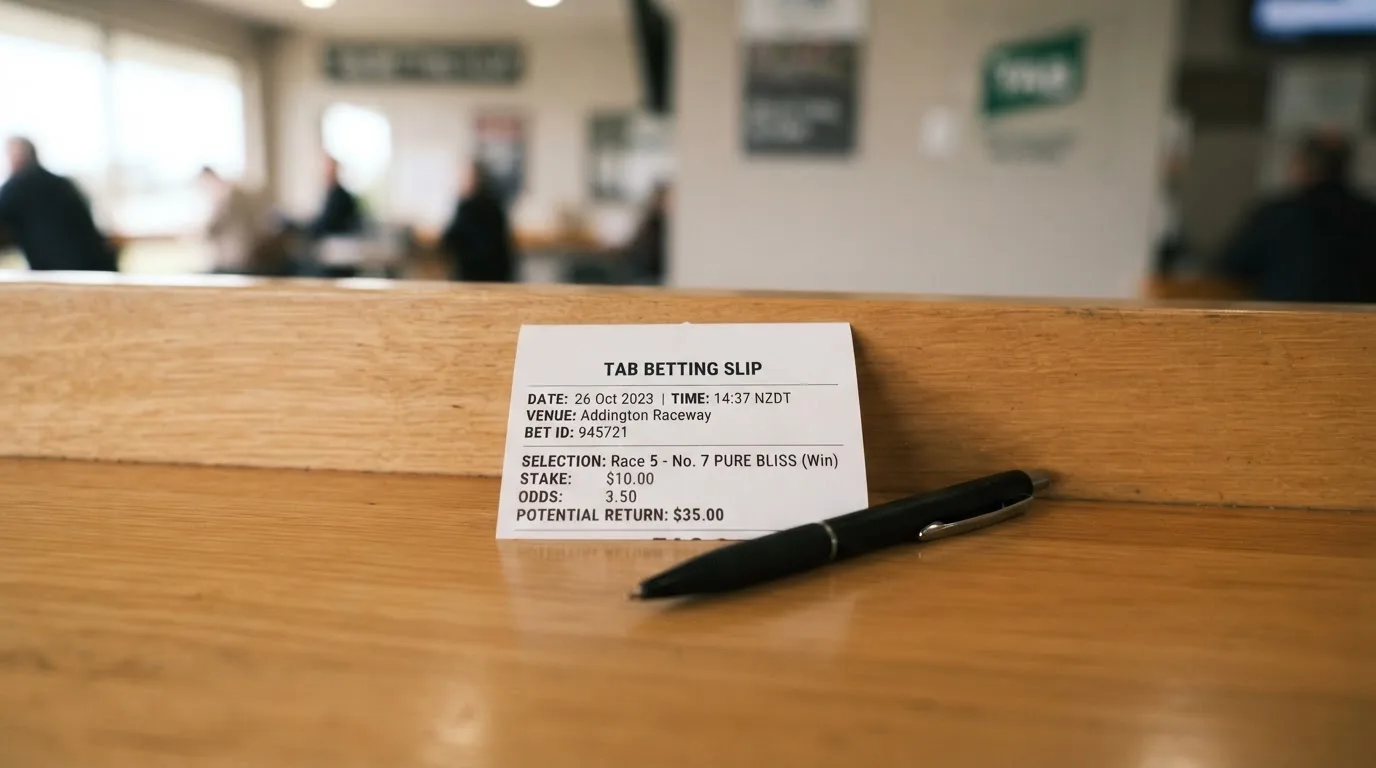
The payout is what a winning bet returns. A bet of NZ$10 at decimal odds of 3.50 returns NZ$35 to the punter (NZ$10 × 3.50), with a net profit of NZ$25 (NZ$10 × (3.50 − 1)). A multi combines the legs: a four-leg multi at odds 1.80, 2.20, 1.95 and 1.70 has combined odds of 1.80 × 2.20 × 1.95 × 1.70 ≈ 13.07, and a NZ$10 stake returns NZ$130.70 if all four legs win. The mechanic is return = stake × odds; the net is profit = stake × (odds − 1). The punter who reads the stake and the odds together reads the line.
The margin is the bookmaker’s cut. In an illustrative two-way market priced at decimal odds 1.90 on either side, the two implied probabilities (1/1.90 each) sum to roughly 1.053, the payout share is about 95.1%, and the margin — the fraction of every dollar matched that the bookmaker keeps on average across the market — is roughly 4.9%, landing in a band of about 4.5% to 5.5% depending on rounding. The punter sees the margin as the gap between what they bet and what the market returns in aggregate. A market with tighter odds (1.85 / 1.85) carries a smaller margin; a market with wider odds (2.10 / 2.10) carries a larger one. The condition the result depends on is the price structure of the specific market.
The expected loss is the cost of clearing a wagering requirement, expressed as a fraction of the turnover. For an offer that requires the bonus to be turned over three times on markets with a 5% margin, the expected cost is roughly 15% of the bonus — the wagering-factor-times-margin calculation that turns a marketing “100% bonus” into its real price. None of the operators on this page publishes a turnover requirement the punter must accept without reading the small print; the punter who reads the small print knows what the offer costs.
A punter who carries those three mechanics in their head walks into TAB NZ or any offshore brand with the same vocabulary and the same questions. The product differences between operators are real. The mechanics are not.
A Direct Comparison of the Cost Shape
Cost, in this comparison, is not a single number: it is the bundle of fees, the bundle of mechanics, and the bundle of legal exposure that come with each choice. TAB NZ’s cost shape is small on commissions (the published margin is whatever the price implies), small on payment friction (NZD in, NZD out), zero on legal exposure (the only lawful online bookmaker with TAB NZ), and small on the depth-of-market factor (the menu is narrower than the broadest offshore books). The offshore cost shape is wider on commissions (the published margin is whatever the price implies), wider on payment friction (currency conversion or crypto exchange), positive on legal exposure (the operator breaches section 74AAA by serving New Zealand customers), and larger on depth-of-market factor (the menu is wider).
A punter who values the protection of New Zealand law picks TAB NZ and accepts the narrower menu. A punter who values the menu picks an offshore brand and accepts the absence of New Zealand law. The comparison does not pick the punter — the punter picks, and the page’s job is to make sure the punter picks with both eyes open.
What to Read Before Depositing Anywhere
Three rules the page will keep returning to, because they make the difference between a bet that ends well and a bet that ends in a complaint. None of them are mine — all of them are the operator’s own published terms, the regulator’s published warnings, or the punter’s own habit.
The first rule is to read the operator’s own terms before depositing. Every operator on the page publishes a betting rules page, a bonus terms page, and a responsible-gambling page; the three pages together tell the punter what the operator is selling and how it is regulated. The punter who reads the three pages before placing the first bet has read the small print; the punter who waits until the small print bites has read it under duress.
The second rule is to read the licence line the way the regulator writes it. A Curaçao licence gives the brand a Curaçao licence; an Anjouan licence gives it an Anjouan licence; neither gives the brand a New Zealand licence. The punter who reads the licence line sees what regulator the operator answers to, and the punter who knows what regulator is on the other end of the brand knows what to do when something goes wrong.
The third rule is to set the harm-minimisation tools before the second deposit, not after. TAB NZ’s app carries deposit limits, time-outs and self-exclusion; offshore brands carry their own tools, and the punter who has set them before a losing streak begins has done the only timing that matters. The Helpline (0800 654 655) and the text line (8006) sit outside the operator; the punter who has the number in their phone before they need it has done the same.
The Costs a Punter Pays That Are Not on the Betting Slip
Three costs never appear on a betting slip and are not in any published margin.
The first is the cost of a missed self-exclusion. A punter who has lost the right to bet at TAB NZ has still lost the right at Betcha, and a punter who has self-excluded from one offshore brand has not self-excluded from another. The cost is the loss of control over a tool that is not centrally enforced, and the fix is the punter setting the tool at every operator the punter has used. The Helpline is the backstop for any punter who has run out of self-exclusion options.
The second is the cost of an offshore dispute. The punter who has bet with a Curaçao-licensed bookmaker and has not been paid out sits inside a Curaçao-licensed arbitration framework. The cost is the legal distance between the punter and the operator, and the fix is to read the operator’s published complaints process before depositing.
The third is the cost of a market the punter did not understand. A Bet Builder with a voided leg voiding the whole slip is the operator’s rule, and the punter’s defence was to read it before placing the bet. A market priced at decimal odds 2.10 with no other context carries the bookmaker’s margin in it, and the punter’s defence was to read the implied probability. The cost is the gap between what the punter thought the price meant and what the operator meant the price to mean, and the fix is the mechanics in the section above.
A punter who has done all three jobs has paid nothing any of them cost. The costs the punter does pay are the costs the punter accepted by not doing the three jobs.
What This Page Is Not For
A “best of” page can be misread as a recommendation. The page is not a recommendation. It is a comparison of cost and product, set against the legal frame the regulator enforces, for a punter who has decided to bet and who prefers to bet with the law visible than with it assumed. A punter who has already chosen the brand and is looking for a sign-off has come to the wrong page; a punter who has decided to bet and wants the costs before the bet has come to the right one.
A “best of” page can also be read as a tip. The page is not a tip. It does not say who wins, because nobody knows who wins, and the punter who acts on a tip a page carries has acted on the page’s word. The mechanics section is the closest the page gets to prediction — it says what the odds imply, not what the odds predict.
The page describes the operators in the order the regulator expects them to be described, and it judges each operator on the cost shape it asks the punter to take. It does not recommend a brand; it does not invite a sign-up; and it does not publish a working promotional code. A punter who reads the page and decides to bet has made a decision the page has not made for them, and a punter who reads the page and decides not to bet has read the cost shape the page exists to surface.
What a Punter Must Walk Away With
The simplest framing the page can offer: betting is the regulator’s monopoly for the first time in modern New Zealand history, the monopoly is enforced through the operator and not through the punter, and the choice a New Zealand punter actually makes is between the regulated product the law points to and the offshore product the law has closed. A punter who picks TAB NZ has picked the regulated product; a punter who picks an offshore brand has picked the product the law has closed, with whatever consequences that carries for the punter’s complaint route, the punter’s harm-minimisation access and the punter’s payout distance.
The mechanics of betting — payout, margin, expected loss — are the same on either side of that choice, and the punter who understands the mechanics reads the line at TAB NZ and at the offshore books the same way. The breadth of menu is real; the protection is real; the two do not trade against each other in the usual sense, and the trade-off the punter actually makes is the one the law has set.
Frequently Asked Questions
Which bookmaker may lawfully take sports and racing bets in New Zealand?
Since 28 June 2025, section 74AAA of the Racing Industry Act 2020 lets only TAB NZ take those bets from people in New Zealand. TAB NZ operates through its two online brands, TAB and Betcha. Any other operator taking bets from inside New Zealand is in breach of the section, and the Department of Internal Affairs told such operators to withdraw from New Zealand customers with immediate effect.
How is the return on a bet worked out from the stake and the odds?
Return equals stake multiplied by the decimal odds. For a stake of NZ$10 at decimal odds 3.50, the return is NZ$35 and the net profit is NZ$25. For a multi, the legs multiply into a combined price before the multiplication — a four-leg multi at 1.80, 2.20, 1.95 and 1.70 has combined odds around 13.07, so NZ$10 returns NZ$130.70 if every leg wins.
What is the bookmaker’s margin and how can it be seen in the odds?
The margin is the fraction of every dollar matched that the bookmaker keeps on average across the market. For an illustrative two-way market priced at 1.90 on either side, the two implied probabilities sum to about 1.053, the payout share is about 95.1% and the margin is roughly 4.9% — somewhere in a band of about 4.5% to 5.5% depending on rounding. Tighter odds mean a smaller margin; wider odds mean a larger one.
What does a player lose by betting with a bookmaker that has no New Zealand licence?
The player loses the New Zealand regulator’s complaints route, the New Zealand harm-minimisation framework TAB NZ’s apps carry, and the leverage of an operator the Department of Internal Affairs can require to answer. The Department warns that overseas operators may be in jurisdictions with minimal safeguards, may not return unspent credits and may not pay out large wins. Section 19(4) of the Gambling Act 2003 says the player cannot be convicted for placing such a bet.
From what age can bets be placed with TAB NZ, and what is checked when opening an account?
TAB NZ’s own rule is 18 or over — betting under 18 is an offence under section 89 of the Racing Industry Act 2020. The account-opening checks include a verified New Zealand address and ID, in line with TAB NZ’s published account-opening terms. The TAB NZ app’s App Store age rating is 17+, an Australian-and-NZ storefront default, and the operator’s own 18+ rule is the one that governs betting on TAB NZ.
Are betting winnings taxed in New Zealand?
Inland Revenue’s published guidance says recreational gambling winnings are generally not taxable, and prize money from TAB horse, dog and trotting races is explicitly not taxable. A punter who bets as a business sits outside the recreational case, and the line between recreational and business is a question for an accountant, not a betting site. Operator-side, TAB NZ pays a Problem Gambling Levy of 0.74%; offshore operators supplying New Zealand residents pay online gambling duty on their profits, though paying duty does not make the offer lawful.
Prepared by the Kiwibettingsites editorial staff.